AI SEO Tools Comparison in 2026: A Strategist's Honest Take.
AI visibility tools answer three different questions. Is my site built so AI can read and trust it? How often does AI mention me? Is a change in those mentions real? Classic SEO suites answer the first question only partly. Daily trackers such as Peec AI and Profound answer the second, across many engines. The Three-Layer Approach (3LA) answers the first with deterministic structural scoring and the third with repeated sampling and confidence intervals. Most teams need more than one of these. The useful thing is to know which question each tool is actually answering.


Byline: Nickolass Jensen, Founder & CEO, Nettpilot AS Published: July 5, 2026 · Updated: 16 October 2026 Update note Updated October 2026 with results from the first 3LA Benchmark Engine series and a corrected comparison of AI visibility trackers. This article was first published on nettpilot.com.
AI SEO tools at a glance (2026)
| Classic SEO suites (Semrush, Surfer) | Daily AI trackers (Peec AI, Profound) | 3LA | |
|---|---|---|---|
| Main question | How do I rank in Google? | How often does AI mention me? | Why does AI cite me or not, and is a change real? |
| How it measures | Rankings, on-page analysis; Semrush also offers AI visibility tracking | Runs a fixed set of prompts against AI assistants, typically once a day per model[^1] | Deterministic structural scoring (LayerScore), repeated-sample benchmarks with confidence intervals, server-log verification of AI crawlers |
| Engines covered | Google, plus AI tracking add-ons | Broad. Profound lists up to nine engines, including Google AI Mode, Copilot and Claude[^2]; Peec AI also covers AI Mode | Benchmark Engine: Gemini (with Google Search), Perplexity, ChatGPT with and without web search. Not yet: AI Mode, Copilot, Claude |
| Strength | Mature keyword and site data | Wide, continuous monitoring, integrations (API, MCP, Looker Studio for Peec AI[^1]), recommendations | Separates signal from noise; shows what to fix in the page structure |
| Limit | Built around blue-link search | One sample per prompt per day cannot separate a real change from random variation | Fewer engines; Brand Analyzer (own-brand monitoring) currently runs one answer per question; benchmark data via API/MCP is in development |
Why one AI answer a day is not a measurement
AI assistants do not give the same answer twice. Ask the same question twice in a minute and you can get a different list of brands. That matters, because most AI visibility dashboards are built on one answer per prompt per model per day.
In October 2026 we ran the first series of the 3LA Benchmark Engine. We asked the same purchase questions to ChatGPT, Gemini and Perplexity about online retail in Norway and the UK: 1 728 answers over four runs across three days. For each question we collected several answers per run, so we could compare variation within a run with variation between days.
In the UK data (576 answers), two answers taken minutes apart differed as much as two answers taken on different days. Overlap in the retailers mentioned (Jaccard) was:
| Assistant | Same run | Different days |
|---|---|---|
| Gemini (with Google Search) | 0.76 | 0.76 |
| ChatGPT (memory only, no search) | 0.75 | 0.75 |
| ChatGPT (web search) | 0.70 | 0.70 |
| Perplexity | 0.62 | 0.57 |
For Gemini and ChatGPT, the day-to-day movement was indistinguishable from sampling noise. Perplexity showed a small amount of real drift on top of the noise.
What this means in practice: if a daily dashboard shows your brand up on Tuesday and down on Wednesday, that may be chance. One sample cannot tell you which. Repeated samples and a confidence interval can.
Other findings from the same series (preliminary, four runs):
- The top is stable. The same retailer was ranked first on day one and on the following days in 35 of 36 Norwegian and 17 of 18 UK measurements.
- The tail is not. About 1 in 4 retailers outside the top in Norway, and 1 in 5 in the UK, were mentioned on only one of the days.
- The assistant matters more than the time of day. Morning and evening answers were no more different than answers from different days. But ChatGPT, Gemini and Perplexity agreed on the number one retailer in only 6 of 12 Norwegian categories and 1 of 6 UK categories.
- The leaders live in the model’s memory. 7 of ChatGPT’s 10 most-mentioned Norwegian retailers were the same with and without web search (10 of 10 in the UK).
- Consumer bodies are the biggest outside source. Retailers’ own sites made up around 40% of cited sources. The largest third-party sources were Forbrukerrådet in Norway and Which? in the UK.
Retailer names are not published. Nettpilot sells GEO services and is measured, but never ranked, in 3LA benchmarks.
Two kinds of measurement, and why 3LA uses both
1. Structure is deterministic. Whether a page proves its key claims with Schema.org is not a matter of opinion. 3LA scores it the same way every time. The same page gives the same number:
- Structural Proof Gap (SPG): how many of the page’s intent-critical claims (price, service, FAQ, rating, organisation, location) are proven in structured data, not only stated in prose.
- Consistency & Redundancy Gap (CRG): whether the same fact appears in more than one independent structure (body text, table, JSON-LD), so a model can cross-check it.
LayerScore is diagnostic. It shows where a page is structurally weak. It does not predict or guarantee that an AI will cite you.
2. AI answers are not deterministic. So they have to be measured statistically: several samples, the same questions across days, and a confidence interval around every share. That is what the Benchmark Engine does. It also runs ChatGPT with and without web search, so you can see whether a brand is visible because of what the model remembers or because of what it finds live.
Between the two sits crawl verification: the 3LA Log Analyzer shows which AI bots actually request your pages, on any website. Nettpilot Guardian controls which bots get access on WordPress.
Three layers, because AI visibility is not one thing
- Layer 1 – Human / Relevance: does the content solve a real problem well enough to pass the models’ quality filters?
- Layer 2 – Search / Code: semantic HTML, a deliberate
/llms.txt, a robots.txt that addresses AI bots, and Schema that matches the business model. 3LA classifies service and product businesses automatically and lets you correct it. - Layer 3 – AI / GEO / Credibility: trust signals such as partners, certifications and customer quotes, read structurally the way real websites are built.
Context-aware advice: an auto repair shop should not be told to add Product/Offer schema. 3LA recognises a service business and recommends AutoRepair/Service with serviceType, areaServed and opening hours.
Human in the loop: if 3LA misreads your business or page type, you correct it in one click. The correction is logged and used to tune the heuristics.
Which tool for which job
- Choose a classic SEO suite for keyword research, rankings and site audits in Google.
- Choose a daily AI tracker (Peec AI, Profound) if you need wide, continuous coverage across many AI engines, including Google AI Mode, and integrations into existing reporting.
- Choose 3LA when you need to know why AI cites you or not, whether an observed change is real before you act on it, and which structural fixes to make.
- Combine them: a daily tracker can flag that something moved. A repeated-sample benchmark can confirm whether it did.
Action checklist
- Audit each key page for Structural Proof Gap and close it with the matching Schema.org type.
- Publish a deliberate
/llms.txtthat names your most citable sections. - Make trust signals machine-readable: semantic sections, descriptive alt text, Review/Brand schema.
- Check your server logs to see which AI bots crawl you.
- Before acting on a change in AI visibility, ask how many samples it is based on.
Frequently asked questions
Do AI assistants give the same answer every time? No. In our UK data, two answers to the same question taken minutes apart differed about as much as answers from different days.
Can a daily AI visibility tracker tell whether a change is real? Not from one sample per prompt per day. It needs repeated samples or a long enough trend to separate change from random variation.
Does a higher LayerScore guarantee more AI citations? No. LayerScore is a diagnostic of structural weaknesses across three layers. It shows where to invest effort. It does not predict citation.
Which AI engines does the 3LA Benchmark Engine cover? Gemini with Google Search, Perplexity, and ChatGPT with and without web search. Google AI Mode, Copilot and Claude are not yet included.
Is the 3LA Brand Analyzer the same as the Benchmark Engine? No. Brand Analyzer monitors your own brand with one answer per question. Repeated sampling with confidence intervals is specific to the Benchmark Engine.
Sources [^1]: Peec AI, FAQ: “executes each prompt once every 24 hours on every AI model you’ve selected”; REST API, MCP, Looker Studio. peec.ai, verified 16 October 2026. [^2]: Profound, product and methodology pages, verified October 2026. 3LA Benchmark Engine, online retail series Norway and UK, 10–12 October 2026, 1 728 answers. UK sample-level data: 576 answers.
Last verified: 16 October 2026.
Want to know whether a change in your AI visibility is real?
→ Norwegian: Bli kjent med 3LA Benchmark Engine (på norsk)
→ English: Learn about the 3LA Benchmark Engine (in english)
Nickolass Jensen is the founder and CEO of Nettpilot AS, a Norwegian digital agency specialising in technical SEO, GEO and WooCommerce development, and the creator of the Three-Layer Approach™ (3LA).
Related articles
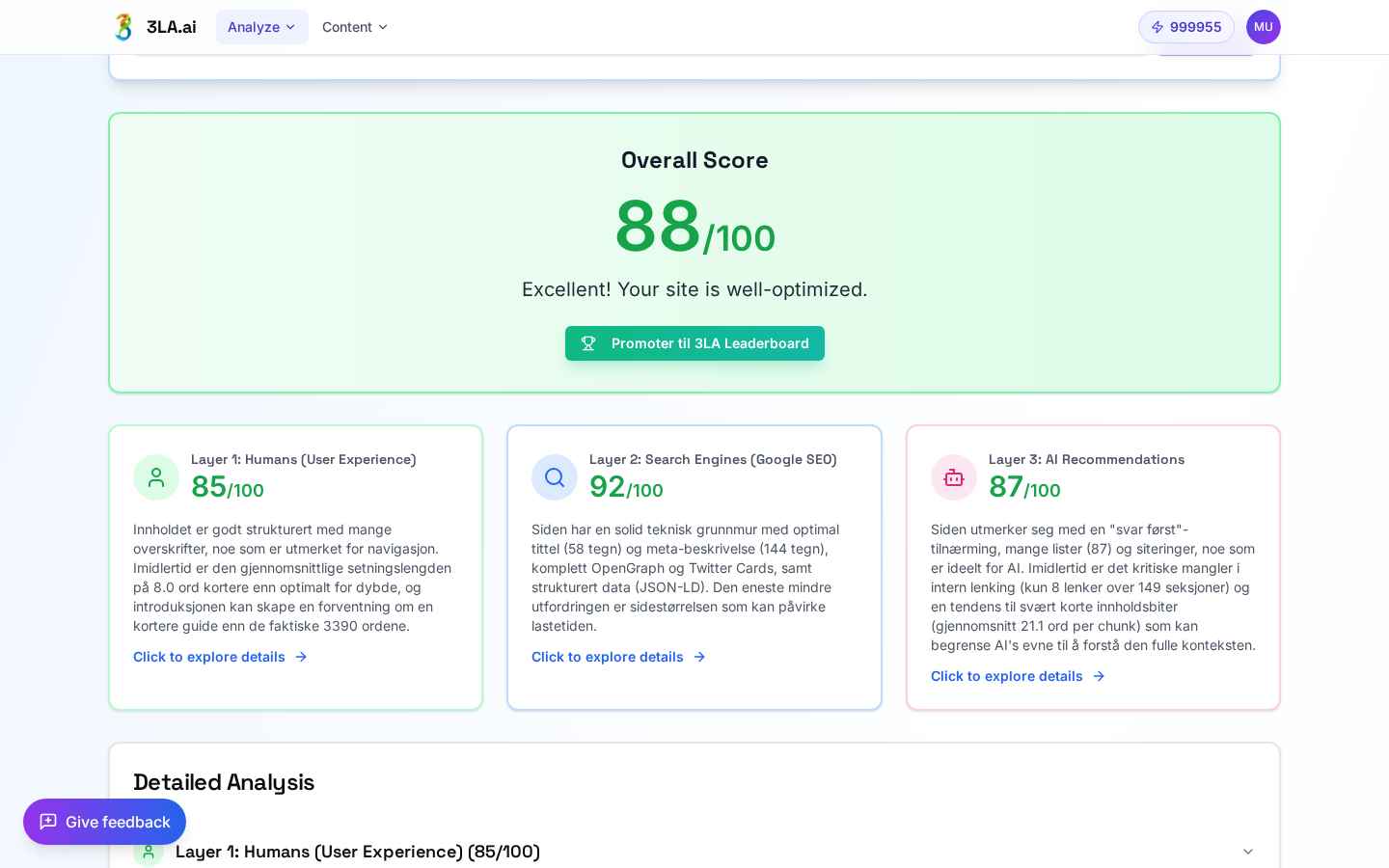
Your SEO Audit has a missing Layer
Most audits cover two layers. The one they skip is where AI visibility is decided.
7 min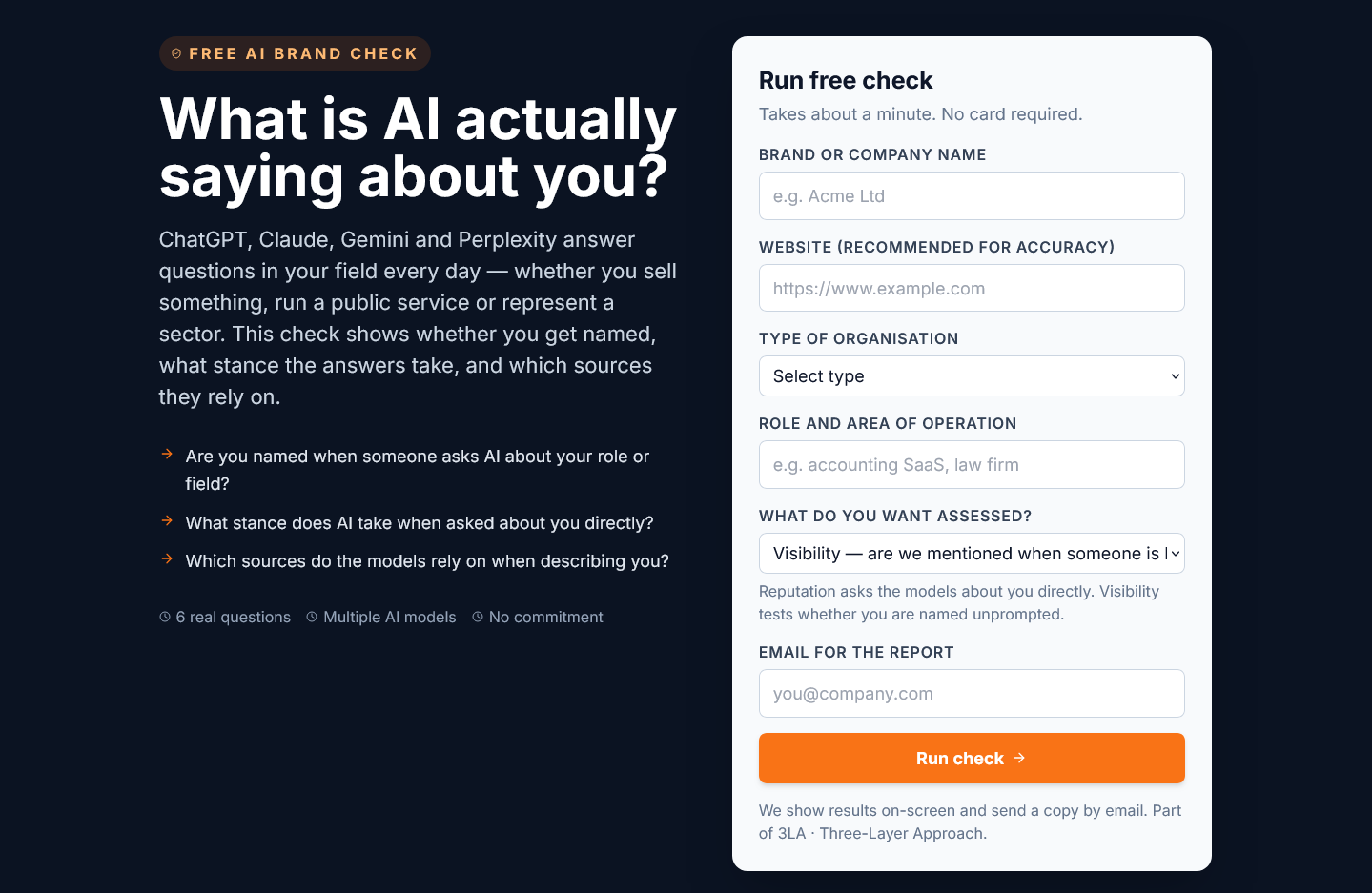
Entity Accuracy Engine - Why we built it and who it's for
LLMs hallucinate about companies, prices, key people and mandates - and it's costing NGOs, universities, research bodies, financial institutions, political actors and agencies real leads and real trust. Here's the background of the Entity Accuracy Engine, and exactly who I built it for.
4 min