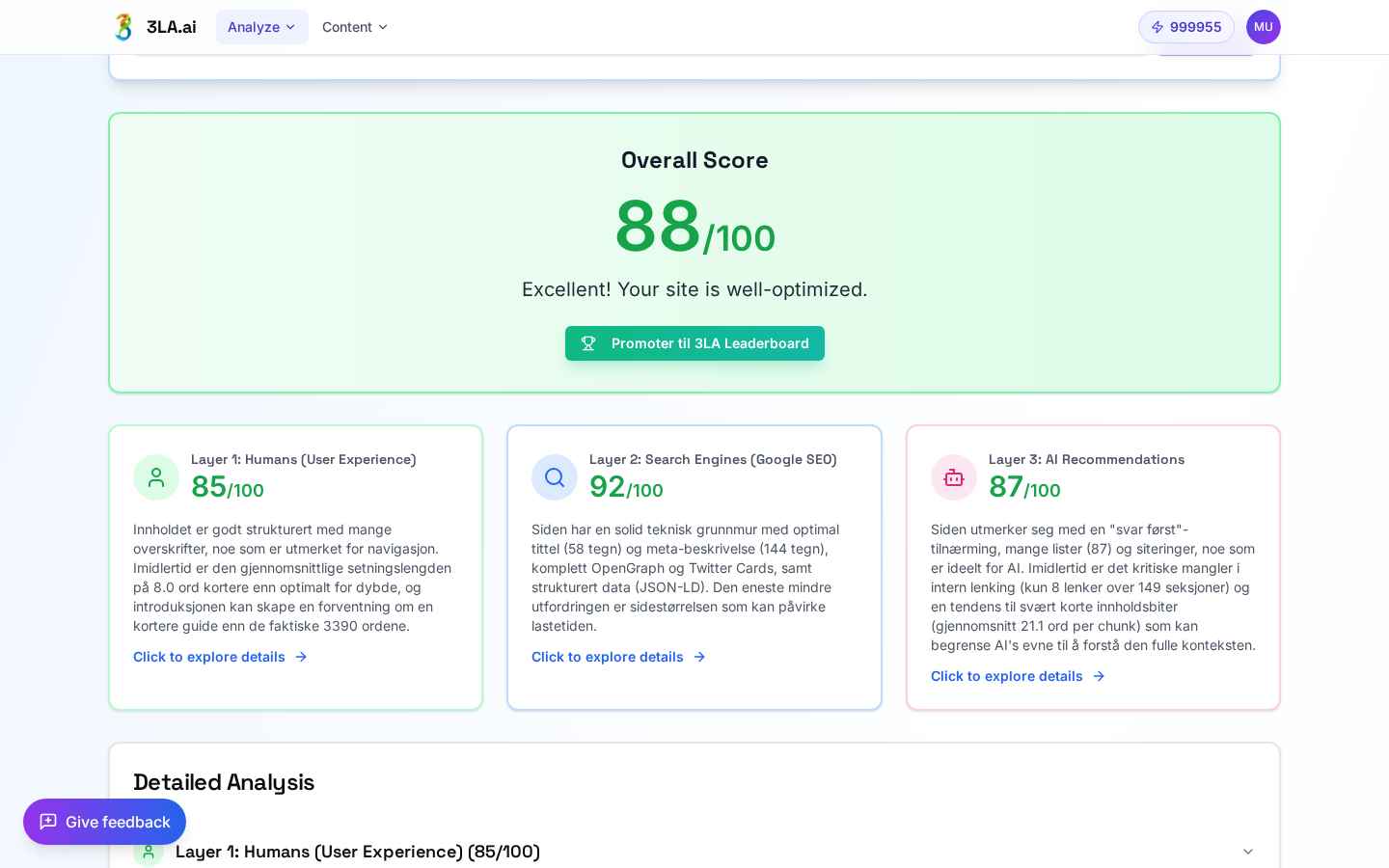
Three-Layer Approach: humans, search and AI.
Three-Layer Approach (3LA) evaluates the same content from three perspectives: L1 — usefulness and trust for people; L2 — access and understanding for search engines; L3 — clear, attributable material for AI systems to reuse. These are complementary quality checks, not three separate websites or a promise of visibility.
One content base. Three different questions.
L1 asks whether the content helps someone. L2 asks whether search engines can access and interpret the page. L3 asks whether an AI system has clear evidence it can use without losing the meaning or limitations. Work on the three together; they are not a strict sequence or three independent ranking factors.
Technical access, credible evidence and clear structure can support more than one layer. Give each finding a primary purpose without pretending it belongs exclusively to one audience. A faster page helps people as well as machines; an accurate source helps a reader as well as an AI-generated answer.
- L1Humans — usefulness and trust
Can a person understand the answer, assess it and take a useful next step?
- L2Search — access and understanding
Can a search engine retrieve, interpret and identify the intended page?
- L3AI — readiness for reuse
Can an AI system identify the claim, its source and its limits when using it in an answer?
Humans — usefulness and trust
Can a person understand the answer, assess it and take a useful next step?
Start with the reader's task. A useful page answers the actual question, explains unfamiliar terms and makes important conditions easy to find. Trust comes from evidence, accountable authorship and honest limits, not simply a confident tone.
- Primary purpose
- Relevance, comprehension, accessibility and the ability to make an informed decision.
- Evidence to inspect
- The visible answer, language, headings, examples, sources and next steps. An automated review can flag issues; only research with people can establish how those people actually understand or use the page.
Questions to investigate
- Give the direct answer early, then explain the conditions and evidence.
- Use headings and paragraphs that help this audience scan and understand.
- Make facts, responsible authors and commercial relationships identifiable.
- Offer a relevant next step without misleading pressure or inaccessible controls.
Illustrative improvement
On a service page, replace a vague promise such as “seamless integration” with the supported use cases, prerequisites and what a customer should clarify before contacting you.
What this does not establish
A readability or L1 score is not an observed satisfaction score, a usability study or a conversion rate.
Search — access and understanding
Can a search engine retrieve, interpret and identify the intended page?
L2 covers search readiness: access, indexing controls, page identity and understandable structure. The page should expose its important content, resolve consistently and connect to the rest of the site. These conditions support discovery; they do not guarantee indexing or a particular ranking.
- Primary purpose
- A reachable page with a clear topic, intended canonical URL and consistent language and indexing signals.
- Evidence to inspect
- HTTP responses, robots and indexing directives, canonical and hreflang, internal links, titles, semantic HTML and structured data that matches the visible facts. Search Console and Bing reports are separate evidence of what happened in search.
Questions to investigate
- Check HTTP status, crawl access and whether important content can be retrieved.
- Align canonical URLs, language alternatives, redirects and the sitemap.
- Use an informative title, heading structure and relevant internal links.
- Keep structured data consistent with what a visitor can actually read.
Illustrative improvement
Give the service page one intended canonical URL, link to it from the relevant topic page and expose the service description in readable HTML. Then check indexing separately.
What this does not establish
A sitemap entry or crawler visit does not prove indexing, ranking, a human visit or an AI citation. Blocking crawling and requesting noindex are different controls.
AI — readiness for reuse
Can an AI system identify the claim, its source and its limits when using it in an answer?
L3 is AI readiness, not a count of how often a model mentions your brand. Make the answer self-contained, the entity unambiguous and the supporting evidence traceable. An Atomic Content Unit is a useful way to organise a claim with its context; it is not a required schema type or an automatic ticket into AI answers.
- Primary purpose
- Material that can be interpreted, attributed and reused without changing what the underlying evidence supports.
- Evidence to inspect
- Explicit answers, named entities, source URLs, dates where relevant, method and limitations. Check that facts agree across the page and its structured data. Treat an automated L3 score as a diagnostic assessment, not an observed citation rate.
Questions to investigate
- Keep the answer, subject and relevant conditions together.
- Link important claims to their original evidence and explain its scope.
- Distinguish an independent source from first-party claims or paid coverage.
- Make each answer useful outside its surrounding paragraph without stripping away caveats.
Illustrative improvement
State which integration the page describes, which systems it supports and which documented prerequisites apply. Keep these facts together so a quoted answer does not turn a conditional capability into a universal promise.
What this does not establish
A high L3 score does not prove that ChatGPT, Claude, Gemini or another service has retrieved, cited or recommended the page. Observe those events separately.
Readiness and results belong in separate columns
A LayerScore summarises an assessment of the available evidence. Inspect the three layer findings alongside any overall score; a single number can hide a serious access or content problem. Compare the same URL and assessment method over time, and record unavailable checks as missing rather than as a measured zero.
- Page assessment
L1/L2/L3 findings and a diagnostic score for a URL at a particular time.
Not proof of audience understanding, search visibility or AI citations.
- Search performance
Indexing status, impressions and clicks within a named report, page set and period.
Not a complete log of questions asked in AI services or an explanation of why clicks changed.
- Observed AI answers
Saved questions, service/model, language, dates, answers, brand mentions and actual source URLs.
An answer sample, not universal coverage. A mention is not necessarily a citation; a citation is not an endorsement.
- Business outcomes
Contact clicks, submitted enquiries and qualified enquiries, each tracked and defined separately.
A click is not a lead, and a citation is not a sale. Attribution requires its own evidence.
State the denominator before comparing rates. Answer-based mention and citation rates use a defined sample of AI answers. Search Insights' Citation Rate (Bing+GSC) relates reported AI citations to combined Bing and Google search impressions; CFR (GSC-only) uses Google impressions only. These cross-report ratios are not answer-sample rates or probabilities that a search impression becomes a citation.
A “dark opportunity” is a hypothesis to investigate: for example, a relevant question where a competitor appeared and you did not in an observed answer. That does not prove lost revenue, high purchase intent or that the question is absent from Search Console.
Apply all three layers to one canonical page
Choose one customer question and the page that should answer it. Keep the facts consistent across readable text, semantic HTML and structured data; the framework does not require three competing URLs or three different versions of the truth.
- Save the current page, its intended audience and a dated assessment of each layer.
- Fix access or identity conflicts, make the answer useful and align claims with their evidence.
- Publish and re-check the same URL. Record the changes and any checks you could not complete.
- Review search reports, repeated AI observations and contact goals separately. Use comparable periods and question sets before interpreting a change.
The free audit, Content Optimizer and monitoring tools have different scopes. Opening an optimiser is not the same as running a live citation test. Check the selected flow and its current terms rather than assuming every audit includes every AI service.
Frequently asked questions
What are L1, L2 and L3 in the Three-Layer Approach?
L1 is usefulness and trust for people. L2 is access and understanding for search engines. L3 is readiness for AI systems to interpret and reuse attributable material. The same page can improve in all three layers without promising that a search engine or AI service will select it.
Is L3 the same as AI visibility or brand monitoring?
No. A page's L3 or GEO score is a readiness assessment unless a report explicitly documents observed answers. Brand monitoring records which brands and sources appeared in a defined set of AI responses. Those observations should remain separate from the page score.
Does 3LA replace SEO?
No. Search readiness is L2, and its foundations also support people and AI systems. The framework adds explicit human and AI perspectives; it does not declare SEO obsolete or make every AI service behave like Google.
Does a high score guarantee citations or enquiries?
No. A diagnostic score helps prioritise changes. Citations, mentions, clicks and qualified enquiries are different observations with different evidence requirements. Check them separately rather than inferring them from the score.
Do I need three pages or special AI markup?
No. Keep one intended canonical page per topic and consistent facts across its formats. Structured data must match visible content. Google does not require special AI markup or llms.txt for its Search AI features; this is not a universal specification for every AI service.
Does every audit test all AI models live?
No. A page audit and live answer monitoring are different activities. A live test must document the service or model, question, date and returned answer or source data. Do not assume model coverage, response times or free access from the framework itself.
How should I compare results across languages?
Keep the language, intended audience, page set and questions explicit. Hreflang helps express page alternatives; it does not guarantee multilingual reach. Compare like-for-like observations instead of merging different language samples into an unexplained score.
Sources and scope
The layer definitions describe the 3LA method. Google guidance below concerns Google's own Search features, not a disclosed cross-platform ranking model. The examples are illustrative improvements, not measured customer results.
- Google Search Central: AI features and your website
- Schema.org: the open vocabulary for structured data on the web
- W3C: web standards and accessibility guidelines
- Bing Webmasters: how Bing delivers search results
- 3LA GEO guide: metric definitions and limitations
- The GEO tool landscape 2026: monitoring vs. execution
Put the framework into practice
Choose the next improvement, not just the next score.
Start with a page that matters to your audience. If you are unsure whether the gap is content quality, access or measurement, we can help you distinguish the problem before you invest in more content.
Discuss your next step →