From Findable to Citeable
SEO made your content discoverable. The Three-Layer Approach makes it authoritative - so AI doesn't just find you, it cites you.
The Shift: SEO vs. AI Optimization
Traditional SEO puts you on the right bookshelf. AI optimization gets you cited in the research paper. Users no longer click as much as they used to - AI retrieves the answer directly. Your content needs to be the source it trusts.
Structured Data (JSON-LD)
+20% increase in AI score. Machine-readable markup tells AI exactly what your content is about.
BLUF Format
+15% increase. Bottom Line Up Front - most important information first. Builds AI trust.
Verifiable Facts
+10% increase. AI trusts content backed by data and credible sources. High Confidence Score = citeability.
The 3LA Score: The New Formula
We measure content across three layers simultaneously. Every piece of content gets a single 3LA Score that tells you exactly how visible you are. Layer 3 is also known as the GEO Score.
Human Layer
30%
Readability, BLUF structure, scannability. Does a real person actually want to read this?
Search Layer
40%
Semantic HTML, SEO metadata, structured data (JSON-LD). The technical foundation that makes you discoverable.
AI Layer
30%
Summary quality, key takeaways, AEO optimization. Can an AI confidently cite your content?
How 3LA Implements This
Three tools, one workflow. From discovering what's wrong to publishing what's right - in minutes, not weeks.
Step 1
Discover - 3LA Audit
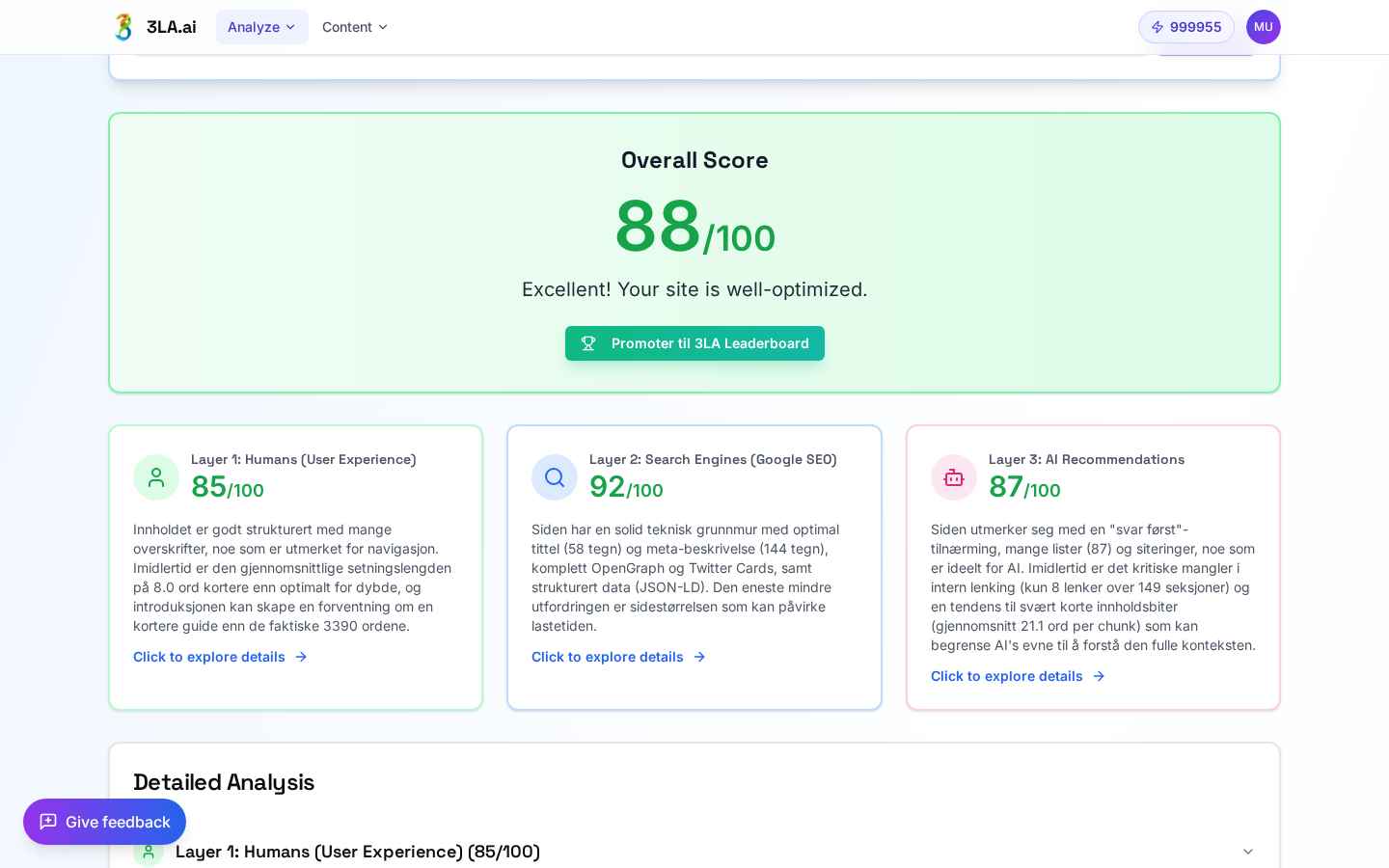
Enter any URL and get a complete analysis across all three layers. The audit scores your content on human readability, technical SEO, and AI-readiness - then tells you exactly what to fix.
- 3LA Score with per-layer breakdown
- AI chat assistant (Ulf) explains every finding
- Export as PDF, Excel, or PNG
Step 2
Transform - Content Optimizer
Paste a URL and the Optimizer rewrites your content for all three layers simultaneously. What used to take 2-4 hours now takes 30 seconds. Your brand voice stays intact with saved Brand Context.
- Layer 1 (Human): BLUF-optimized, readable text
- Layer 2 (Search): Semantic HTML + SEO metadata + JSON-LD
- Layer 3 (AI): Summary + key takeaways for LLM retrieval
Step 3
Publish - WordPress Connector
One click. Your optimized content goes straight to WordPress - with Layer 2 as the main content, Layer 1 as the excerpt, and all SEO metadata auto-filled. Works with Yoast, RankMath, SEOPress, and AIOSEO.
- Publish as draft, pending review, or live
- Auto-fills meta title, description, and focus keyword
- JSON-LD structured data stored as custom field
The Full Digital Picture
AI doesn't judge you on your website alone. It stitches together three layers of reality - what lives on your site, what's said about you across the web, and how your brand travels socially. 3LA measures all three and folds them into one score.
On-site
Your website & content
Off-site
Registries & directories
Social
Reach & digital PR
Measure & Monitor
Publishing is only half the story. These modules track whether your content actually earns AI visibility - and turn real search demand into your next cite-worthy pages.
AI Prompt Tracker
Turns your Search Console & Bing queries into LLM-style prompts, auto-clustered by theme - so a 400-query list becomes a dozen topics worth making citeable.
Explore Prompt TrackerAnalytics
Privacy-friendly, first-party analytics that surfaces AI referrers (ChatGPT, Perplexity & more) next to pageviews, unique visitors, scroll depth and time-on-page per channel.
See AnalyticsBot Tracker
Classifies every AI crawler as cite-worthy, neutral or hostile, links crawl activity to real citation events, and generates an AI-aware robots.txt in one click.
Explore Bot TrackerBeyond Your Website
Your own site is just one signal. AI models build entity trust from your entire digital footprint - business registries, local directories, NAP consistency and social proof. These two modules measure the reality your website alone can't show.
Digital Presence Score (DPS)
A snapshot of your digital foundation - the registry, directory and NAP signals AI uses to build entity trust. Runs an AI web search + NAP analysis and checks name/address/phone consistency and citations across Brønnøysund, 1881, Google Business Profile, Gule Sider, Proff and more.
See Digital FootprintSocial Reach
Measures your brand's traction across social media and digital PR - reach, engagement, publishing cadence and media mentions - combined into one Social Reach score, so off-site momentum counts toward your AI-readiness too.
See Social ReachThe Philosophy Behind the Tools
These tools are built on a manifesto: the belief that content must work for three audiences at once. Read the full framework to understand why we measure what we measure.
Read the ManifestoReady to Make Your Content Citeable?
Start with a free audit. See your 3LA Score. Then transform and publish - all in one place.
The Context Wars: Strategic Architecture for the Agentic Economy
Complete technical framework - ACU design, context caching economics, TTD-DR and pricing arbitrage analysis.
Step 1: Discover the gap with a three-layer audit
Choose a public page and run a three-layer audit. The platform scores every URL across Layer 1 (human readability and trust), Layer 2 (technical SEO and structured data) and Layer 3 (AI-citability and GEO grounding). Separate problems that stop access, such as a blocked crawler, from problems that weaken the answer, such as an unclear heading or unsupported claim.
- Layer 1 checks: sentence length, heading structure, scannability, BLUF format, content length.
- Layer 2 checks: meta tags, canonical setup, structured data (JSON-LD), robots directives, sitemap presence.
- Layer 3 checks: chunk optimisation, answer-first format, citation readiness, verifiable facts, IndexNow.
Step 2: Diagnose with drill-down recommendations
Each layer score comes with prioritised recommendations. The audit identifies which fixes move the needle most — a missing H1 matters more than a suboptimal sentence length. Use Brand Analyzer to see how AI models currently describe your brand, and Log Analyzer to check which AI crawlers visit your site.
Step 3: Improve content for all three audiences
Use Content Optimizer to rewrite text for readability (L1), search structure (L2) and AI-citability (L3) in a single pass. Pippa Content Studio generates structured drafts from a brief with atomic content units, claim-level references and FAQ markup. Collab lets analyst and writer work in the same thread with visible handoff badges.
- Content Optimizer: paste a URL or draft, get a version tuned for all three layers.
- Pippa: turn a topic brief into a citation-ready draft with semantic HTML.
- Collab: shared thread with status badges like 'Suggests Pippa' and 'Content Ready'.
Step 4: Publish, verify and monitor
Publish through the WordPress Connector or your normal workflow. Re-audit the live URL and compare against the baseline. Monitor search performance via Search Insights (Google Search Console integration) and AI visibility via AIR and Brand Analyzer. The Command Center fuses all modules and answers the question: what should I do next?
Frequently Asked Questions
How long does a 3LA audit take?
A standard three-layer audit completes in approximately 45 seconds. It scores any public URL across Layer 1 (human readability), Layer 2 (search-engine access) and Layer 3 (AI-citability and GEO grounding signals).
What is the difference between an audit score and an AI citation?
An audit score is a diagnostic assessment of page readiness. An AI citation is an observed event where a language model references your content. A high score helps prioritise improvements but does not guarantee citations.
Do I need technical skills to use 3LA?
No. The platform is designed for content teams, SEO professionals and agency managers. The audit runs automatically, Content Optimizer generates ready-to-publish text, and WordPress Connector publishes with one click.
Which AI models does 3LA monitor?
Brand Analyzer probes GPT, Claude, Gemini, Perplexity and Mistral in parallel. Log Analyzer identifies visits from ChatGPT-User, PerplexityBot, ClaudeBot, Googlebot and 200+ other crawlers.
What happens after I publish improved content?
Re-audit the live URL to confirm the score improvement. Then monitor search performance via Search Insights and AI visibility via AIR and Brand Analyzer. Compare like-for-like periods before attributing changes.
FROM THE BLOG
Latest field notes.

AI SEO Tools Comparison in 2026: A Strategist's Honest Take
AI visibility tools answer three different questions. Is my site built so AI can read and trust it? How often does AI mention me? Is a change in those mentions real? Classic SEO suites answer the first question only partly. Daily trackers such as Peec AI and Profound answer the second, across many engines. The Three-Layer Approach (3LA) answers the first with deterministic structural scoring and the third with repeated sampling and confidence intervals. Most teams need more than one of these. The useful thing is to know which question each tool is actually answering.
A Practical Setup Guide for 3la.ai
Want your brand to be preferred and cited by ChatGPT, Perplexity and Google AI Overviews? This guide walks you through setting up 3la.ai in under an hour, so you can close visibility gaps, optimise your content and compete in AI search (GEO).

BrightonSEO 2026 Just Validated the Three-Layer Approach
BrightonSEO's 10th anniversary edition, held October 8–9, 2026 and drawing roughly 4,500 attendees, was dominated by one theme: GEO (Generative Engine Optimization), AI citations, and agentic recommendations. For anyone building on the Three-Layer Approach, this wasn't new information - it was confirmation.