GEO Guide: From Helpful Answers to AI Visibility and Customer Contact
You do not need to start your content over. Start with the questions your customers actually ask, make the answers easy to understand, and look at what happens next. Here we separate what you can improve, what you can measure, and what the data does not yet explain.
Key takeaways
- Start with the 90-day roadmap — it gives you a structured plan with weekly checkpoints.
- Separate what you can measure (impressions, citations, contact goals) from what you cannot yet prove (causal effect of a single change).
- The eight practices in 'What actually moves citation rate' are the clearest path to citation readiness.
- Visibility is not the same as business results. Define success for your organisation before you measure.
What is GEO — and what does it mean for you?
GEO makes your content easier for AI to find, understand and cite. It is not about writing with AI — it is about making your existing answers usable as sources.
Generative Engine Optimization (GEO) is the work of making content easier for AI systems to find, understand and cite. A useful starting point is the same as for a reader: a specific question, a clear answer and sources that make the answer verifiable.
SEO helps search engines discover and evaluate the page. GEO also pays attention to how an answer can be used in a synthesis. Using AI to write content is not the same as making that content a useful source. You can work on GEO without generating new text with AI.
Look for the gap between three needs: Does the person get help? Can the search engine read and index the page? Can an AI service understand who is saying what, and under which conditions?
What is Citation Rate? Start with the denominator
Citation rate = reported AI citations ÷ total search impressions. Always check the denominator and time period before comparing numbers.
In 3LA Search Insights, Citation Rate (Bing+GSC) is reported AI citations divided by combined Bing and Google search impressions, multiplied by 100. Use the same page set and compatible periods. This is a cross-report product metric, not the probability that a search impression becomes a citation.
The research variant CFR (GSC-only) uses only Google search impressions as its denominator. Label it separately. Google AI impressions are not the same as Bing AI citations, and are already included in Google's overall performance report. Do not add them on top of that total.
The product does not display a rate below 100 search impressions and caps the rate at 100%. A raw ratio can mathematically exceed 100 because the sources count different events. That is not, by itself, proof of authority or a universal target.
- Mention: the business is named. A mention can occur without a link.
- Citation: the source is referenced in an AI answer. This does not establish that anyone clicked.
- Mention rate: the share of a defined answer set that names the business. State the engine, questions and number of runs.
- Bing Citation Share: the site's share of citations for a particular grounding query, not its share of all AI traffic.
- Contact goal: for example, a phone click or a thank-you-page visit. Qualified enquiries and sales need separate confirmation.
How the figures in this illustration fit together
- Reported AI citations
- 1,703
- Search impressions (Bing+GSC)
- 164,938
- × 100 · rounded citation rate
- 1.03%
Different measurements, different questions
Illustration · Nettpilot.com · static screenshot
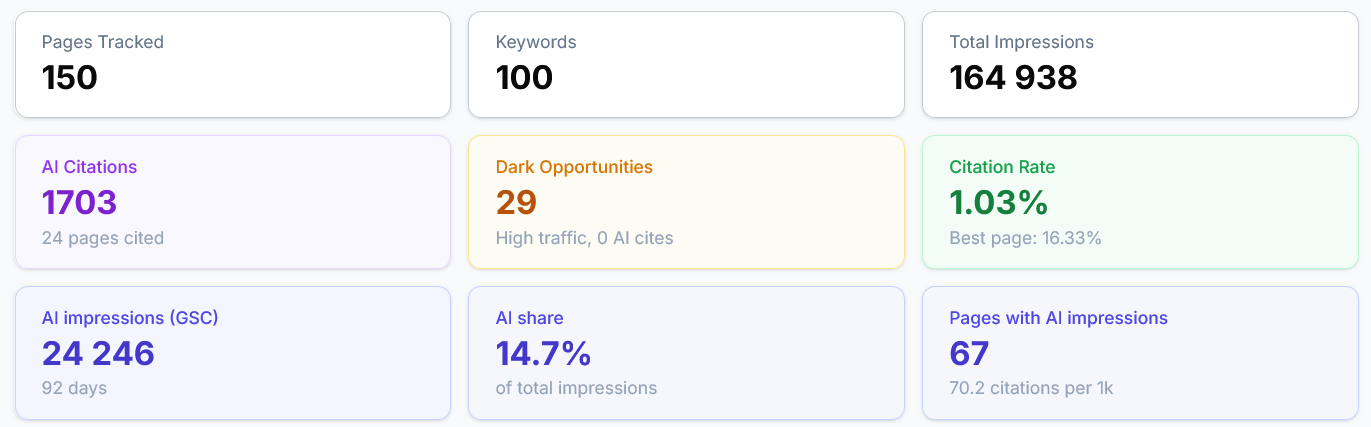
The overview brings several report metrics together. Only the AI impressions (GSC) tile specifies 92 days; exact dates and matching coverage across all tiles are not confirmed. This is a separate illustrative snapshot, not the 125-day case further down.
The original has an imprecise '0 AI cites' label. Dark Opportunities can have citations but a low rate — see the explanation in the next section.
Open original image in a new tab ↗Dark Opportunities: Find pages worth investigating
Dark opportunities are pages with AI impressions but zero or near-zero citations. They are already visible to AI — but not being used as sources. Start here.
A page with search visibility and few reported AI citations can be a useful starting point. In 3LA, a citation rate below 1% and at least 100 search impressions acts as a prioritisation signal. It is not a promise of high returns.
Check report coverage first. Missing data from an AI service does not mean zero citations on that service. Then look at the question the page answers, its supporting sources and whether the answer makes sense without reading the entire website.
Zero clicks at a good search position is consistent with an AI answer meeting the need directly, but does not prove AI Overview cannibalisation. Search intent, result text and other search-result features can also explain the pattern.
A low rate does not mean zero citations
- AI citations · Gemini Enterprise page
- 133
- Search impressions (Bing+GSC)
- 49,496
- × 100 · rounded citation rate
- 0.27%
Citations and prioritisation, side by side
Illustration · Nettpilot.com · static screenshot
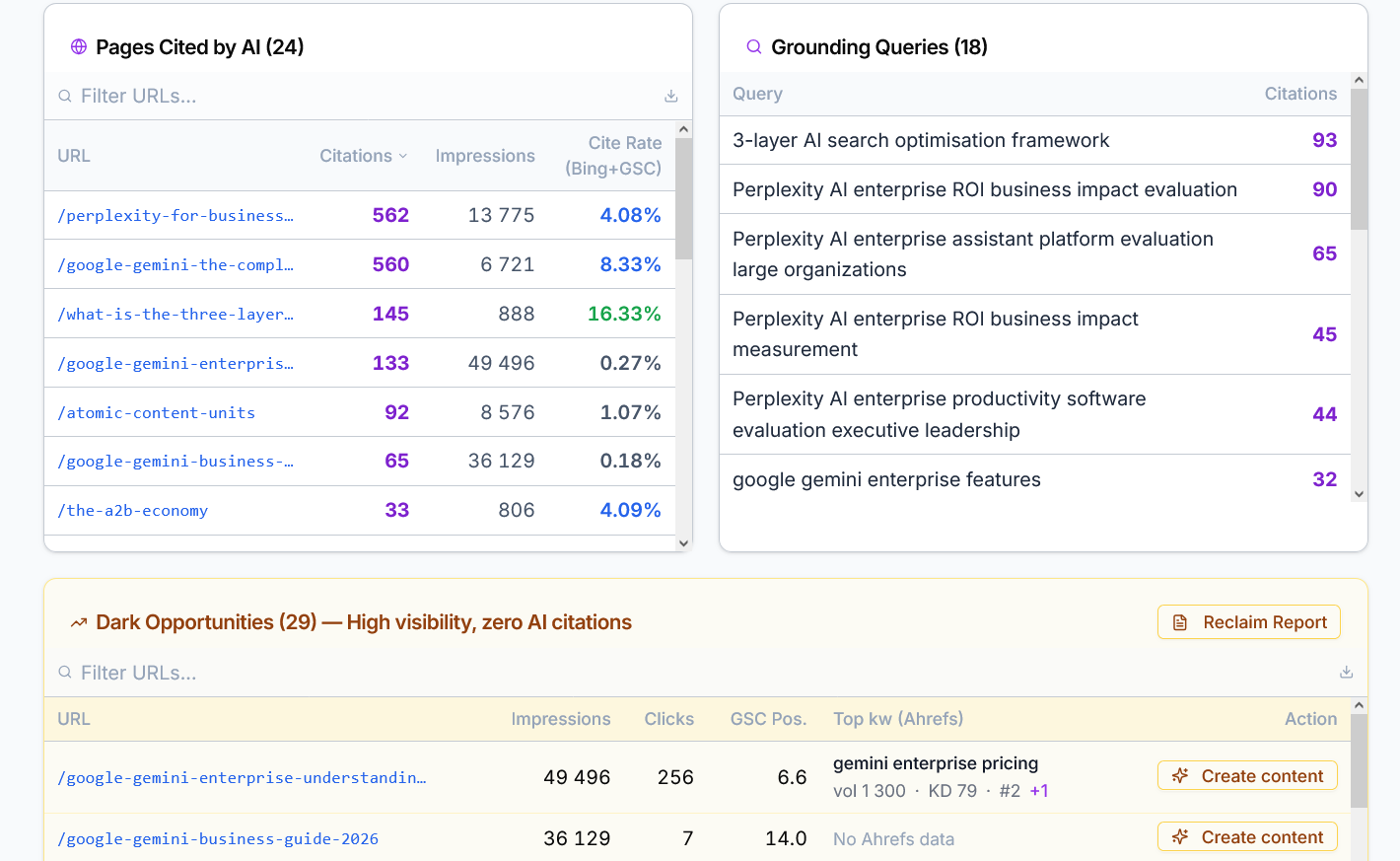
A page can have substantial impressions and actual citations, yet still have a low citation rate. The grounding queries on the right concern source retrieval; they are not necessarily the original user questions.
Notice the old 'zero AI citations' label in the original: it is misleading. The Gemini Enterprise page has 133 citations, not zero. The relevant signal here is a rate below 1% with at least 100 impressions.
Open original image in a new tab ↗Three layers — one coherent answer
The Three-Layer Approach evaluates content for people, search engines and AI. These weights belong to the scoring model; they are not measured contributions to traffic or sales.
- Layer 1 · People · 30%: clear language, readability, trust and a natural next step.
- Layer 2 · Search · 40%: accessible HTML, the correct canonical, useful internal links and structured data that matches the page.
- Layer 3 · AI · 30%: clear concepts, self-contained answers, sources and qualifications that stay with the claim.
Two answers about the same homepage
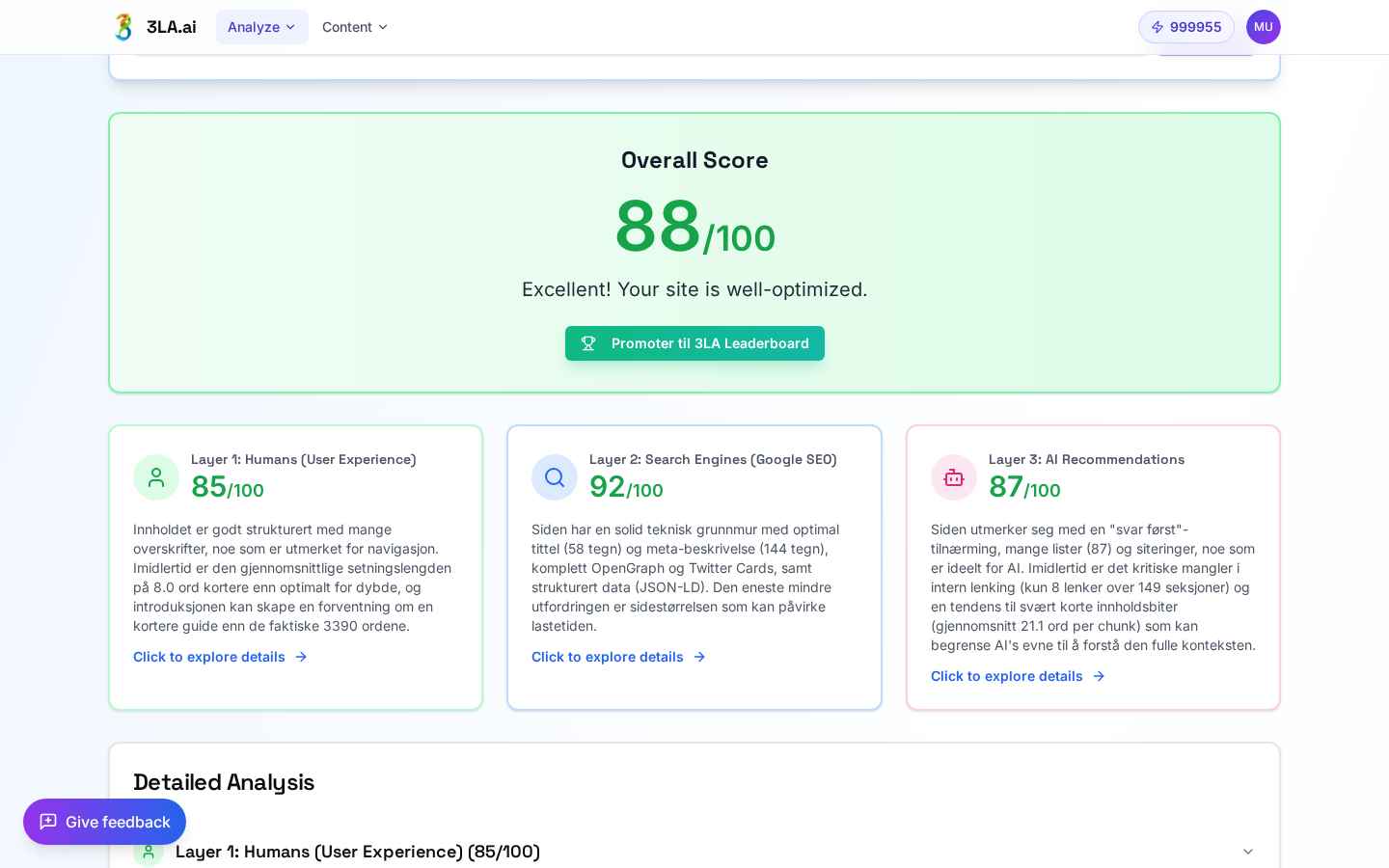
- Overall audit score
- 88
- Reported AI citations
- 25
Readiness is one measurement. Citation is another.
Illustration · Nettpilot.com · static screenshot
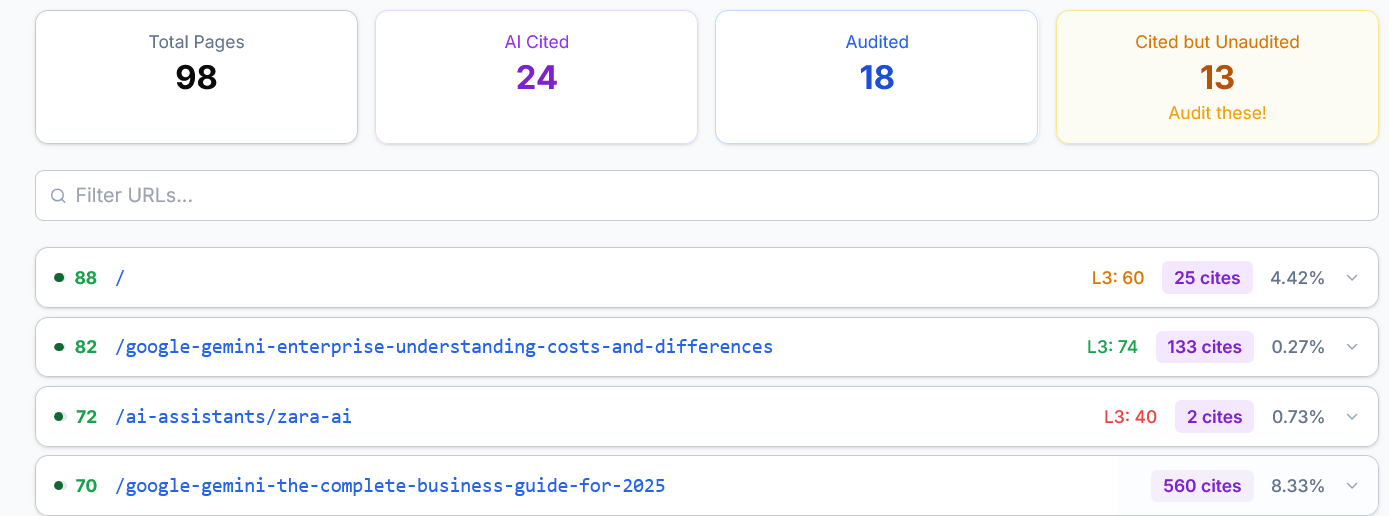
Audit results and reported citations sit alongside each other. This raises useful questions; it does not prove that a particular score caused those citations. This view shows 98 pages; the overview's 150 tracked pages should not be treated as the same population.
Open original image in a new tab ↗What actually moves citation rate?
Eight practices that increase the chance of being cited. None of them guarantee results — but together they make your content structurally easier to use as a source.
These are the practices we see most consistently associated with improved citation readiness. They are not ranked by measured effect size — we do not have controlled evidence for that. They are ranked by how often they appear in documented improvements across our analysis sample.
Each answer should make sense without reading the rest of the page. This is what we call an Atomic Content Unit. AI models extract chunks, not full articles.
Replace 'significant growth' with '29% increase in organic conversions, YTD 2026 vs 2025 (Plausible)'. Verifiable claims are more likely to be cited.
Link to primary research, official documentation or public data within the text. Do not save sources for a footnote at the end.
Write 'according to Aggarwal et al. (KDD 2024)' rather than 'studies show'. Named sources give AI models a reason to trust and cite the claim.
Pages with AI impressions but low citation rates are already being seen by AI. They need better answers, not more visibility.
References from external sources (industry publications, partner sites, directories) strengthen citation authority beyond what on-site content can do alone.
Put the direct answer in the first sentence of each section. Context and caveats come after. This is answer-first format.
Update dates, review figures, and confirm that sources still resolve. AI models prefer recent, maintained content over stale pages.
Visibility is not the same as results
AI impressions show exposure. Business results are measured on your site. Keep these metrics separate — and define success for your organisation type.
What counts as a result depends on who you are. Visibility metrics (impressions, citations, mention rates) describe exposure. Results describe what happens on your own site after someone arrives.
Commercial businesses
- Sales and orders
- Subscriptions and recurring revenue
- Qualified pipeline
- Reduction in support enquiries
- Insight for product and service development
NGOs and non-profits
- Donations
- Memberships
- Campaign participation
- Volunteer sign-ups
- Reduction in unnecessary enquiries
Government and public sector
- Completed digital services
- Self-service adoption
- Reduction in unnecessary enquiries
- Accurate information distribution
- Insight for service development
Hold visibility metrics and result metrics apart. When someone claims a percentage improvement, ask: improvement in what, measured how, over which period?
What do we see in our own analysis sample?
In our analysis sample, based on 753 URLs from 403 domains during October 2025–September 2026, Layer 3 (AI) was the weakest layer on 54% of domains. Layer 2 (Search) was weakest on 32%, and Layer 1 (People) on 14%. Median LayerScore was 61.5; 48% of domains scored 60 or below, while 6.5% scored above 80.
From our broader State of GEO analysis (406 domains, 2,093 audits, updated every 15 minutes): average L3 (AI-citation) score is 69/100, with a typical uplift of +22 points after optimisation.
This is a self-selected sample of domains submitted to 3LA, mainly Norwegian, not a random sample of the web. LayerScore measures structural readiness, not observed AI citations. A low L3 score is consistent with lower AI visibility but does not prove it in isolation. 753 URLs across 403 domains, mostly Norwegian, Oct 2025–Sep 2026. The sample is sites submitted to 3LA, not a random sample of the web.
The Princeton/Georgia Tech/Allen Institute study 'GEO: Generative Engine Optimization' (Aggarwal et al., KDD 2024) shows that GEO optimisation strategies can collectively increase visibility in generative engine responses by up to 40%, though effectiveness varies significantly across domains. The study tests nine distinct content strategies; it does not isolate a precise effect size for 'citing authoritative sources' alone.
That is a reason to investigate the AI layer more closely, not to dismiss the work you have already put into people and search.
Nettpilot.com: Visibility we can document
Nettpilot.com has been developed alongside 3LA. Google Search Console reports the following for the same period, 18 May–19 September 2026 (125 days). These are report totals, not sums of the page table.
- Google AI impressions
- 34,496
- Overall Google search impressions
- 268,203
- Overall Google search clicks
- 586
AI impressions cover Google's generative search features, not ChatGPT, Claude or Perplexity. Do not add them to overall search impressions. The export does not provide a separate AI click or lead count.
The trend is not uninterrupted growth. AI impressions fell from 7,309 during 26 July–22 August to 5,549 during 23 August–19 September 2026. Overall search clicks were 101 and 99 respectively. Both periods contain 28 days.
This is an open practice case from an evolving website, not an isolated study of 3LA's effect. Topics, page count and other changes can affect results. The useful part is being able to follow visibility and decide what to investigate next.
Source: Nettpilot Search Console exports dated 22 September 2026, reconciled against the time series, countries and devices.
BOVG: From pricing questions to AI assistant conversions
BOVG, a Norwegian building and wet-room business, worked with Nettpilot to optimise content around real customer questions — pricing, material choices and project planning. The focus was on making existing answers clearer and more verifiable, not on generating new AI content.
During 18 May–19 September 2026, the site recorded 50,873 Google AI impressions, 6,176 overall Google search clicks and 2,180 reported AI citations in a Bing-format overview report. These are different units, not a combined AI performance score.
Year-to-date (1 January–23 September 2026) compared to the same period the previous year, the overall contact goal conversion rate (thank-you-page visits) improved from 1.6% to 1.9%. Organic search traffic declined 3%, while organic conversions grew 29% and organic conversion rate improved from 1.6% to 2.1%.
AI assistant traffic grew from 97 to 257 unique visitors (+165%). AI assistant conversions grew from 2 to 18 (+800%), giving the AI assistant channel a 7.0% conversion rate — well above the site average. ChatGPT alone accounted for 17 of the 18 AI assistant conversions.
The Plausible extracts below cover a different period: 1 September 2025–31 August 2026, across multiple traffic sources. They show contact behaviour associated with three specific content needs.
| Content and filter | Unique / total | Displayed rate |
|---|---|---|
| Bathroom pricing guide · page filter · phone clicks | 16 / 17 | 0.9% |
| Load-bearing-wall article · entry page · thank-you-page visits | 11 / 12 | 0.7% |
| Plastering/painting price guide · entry page · thank-you-page visits | 14 / 14 | 0.9% |
Estimated average project value is approximately 250,000 NOK, with an estimated net profit of approximately 10,000 NOK per qualified lead. These are internal business estimates, not independently verified figures.
A phone click is not a confirmed conversation. A thank-you-page visit is not, by itself, a qualified lead. The goals and filters differ, so we cannot sum them into 41 unique customers or attribute them to AI.
A conversion is a recorded thank-you-page visit, not a confirmed sale. The AI assistant channel is small (257 visitors) and the conversion numbers are correspondingly low. A high percentage on a small base does not guarantee future performance at a larger scale. Organic traffic declined while conversions grew — meaning the content attracted fewer but more relevant visitors.
The practical lesson: answer real customer questions about price and the work involved, then offer a relevant route to professional help. Verify submissions, spam, duplicates and qualification before reporting leads or sales.
Source: BOVG analytics and Nettpilot collaboration data, year-to-date comparison as of 23 September 2026. Search Console, AI Performance and Plausible extracts supplied in September 2026. The earlier 30-day figure (0.8%→4.1%) was based on an unstable OR-filter window and has been replaced by the YTD main-goal figures above.
How can you make an answer easier to use as a source?
You do not control which sources an AI service chooses. You can make your answer easier to understand and check: identify the author, explain concepts, link relevant primary sources and keep important qualifications next to each claim.
Ahrefs analysed around 17 million citations and reported on 28 July 2025 that cited content was, on average, 25.7% newer by publication age than its organic search-result comparison set. This is an observation with differences between platforms, not proof that a new date earns more citations. Correct content that is actually outdated, not just its timestamp.
JSON-LD can clarify what a page describes, but does not promise a citation. Structured data must match what the reader sees. llms.txt is an optional proposal for content overviews, not a substitute for accessible HTML or a proven shortcut to AI visibility.
Choose a format for the question, not a universal citation rate
We do not have evidence for assigning every listicle, video or FAQ a fixed citation rate. Test the format that makes your particular answer clearest.
- Pricing guide: state what is included, the assumptions and when an individual assessment is needed.
- Comparison: use clear criteria, sources and a date. Do not disguise advertising as independent advice.
- FAQ or practical explanation: answer directly and explain which conditions could change the answer.
- Video: make important explanations available as accessible text too. Choose the format because it helps the customer.
Atomic Content Units: One answer that stands on its own
An atomic content unit is a self-contained answer that makes sense without the rest of the page. This is the format AI models are best at extracting and citing.
An Atomic Content Unit (ACU) is a small, self-contained piece of content: a definition, explanation, table row or FAQ answer. It should make sense to a person even without the surrounding paragraphs.
Think of a pricing explanation: the amount alone is not a useful answer. Include what it covers, its assumptions, the source or calculation basis, and when it was checked. The context can then travel with the answer when it is extracted.
ACU is a way of working on clear content, not a separate schema requirement or a guarantee of indexing and citation.
Checklist: What should you prioritise on one important page?
This checklist helps you assess a page; it is not an AI visibility score. A bot visit documents access, not later use of the page in an answer.
Test visibility without mixing measurements
One answer or one week is a small sample. A long, persona-shaped search phrase is not proof that an AI agent performed the search either.
- Search Console: read overall search clicks and impressions. Use the generative AI features report where available, and check its actual date coverage.
- Bing Webmaster Tools: inspect citations in the supported AI experiences. Grounding queries are searches used to retrieve sources, not necessarily the user's original question.
- Repeat a fixed set of relevant questions in your chosen AI services. Log date, engine, language, question and source links. Named questions test something different from spontaneous visibility.
- Plausible or another analytics tool: keep referral visits, phone clicks, forms and qualified enquiries separate. Cross-filter source, entry page and goal before attributing a contact goal to AI.
Follow one page across the reports
Illustration · Nettpilot.com · static screenshot
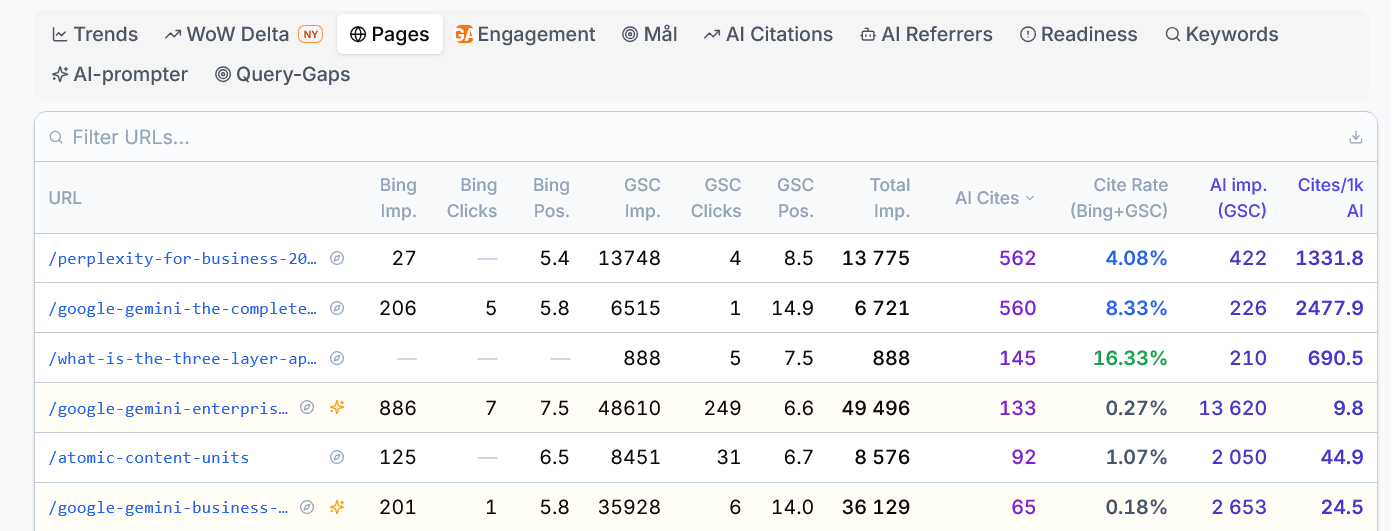
Read the column headings before comparing. Cite Rate (Bing+GSC) and Cites/1k AI use different denominators. The latter is not a percentage, and Google AI impressions do not establish clicks from ChatGPT.
Open original image in a new tab ↗A monthly GEO ritual you can follow through
- Choose a few pages answering important customer questions. Keep a record of baseline data and the current content.
- Improve one clear problem: the answer, sources, structure or next step. Note what changed and when.
- Repeat the same search and AI measurements. Use equal periods and identical filters; note seasonality and other changes.
- Look at contact and quality separately. Keep what helps, and investigate decline as carefully as growth.
The spreadsheet below has no prefilled results and separates readiness, sources, periods and contact goals. The workflow carries no timing or performance guarantee.
Download the measurement spreadsheet (XLSX) ↓Third-party sources: Make expertise verifiable beyond your own website
Share useful research, contribute expertise and keep information about your business accurate. Independent sources can offer context beyond your own product claims. A publication mention is not evidence of a particular citation uplift, however. Distinguish editorial coverage from paid placement, and avoid buying links intended to manipulate search results.
Your tools should answer different questions
- 3LA audit: what should improve in the content's readiness for people, search and AI?
- Search Console and Bing Webmaster Tools: what visibility and source use has actually been reported?
- Search Insights: how can compatible exports support better prioritisation?
- Plausible and the customer system: which contact goals were recorded, and which became real enquiries?
From a search question to a possible content task
Illustration · Nettpilot.com · static screenshot
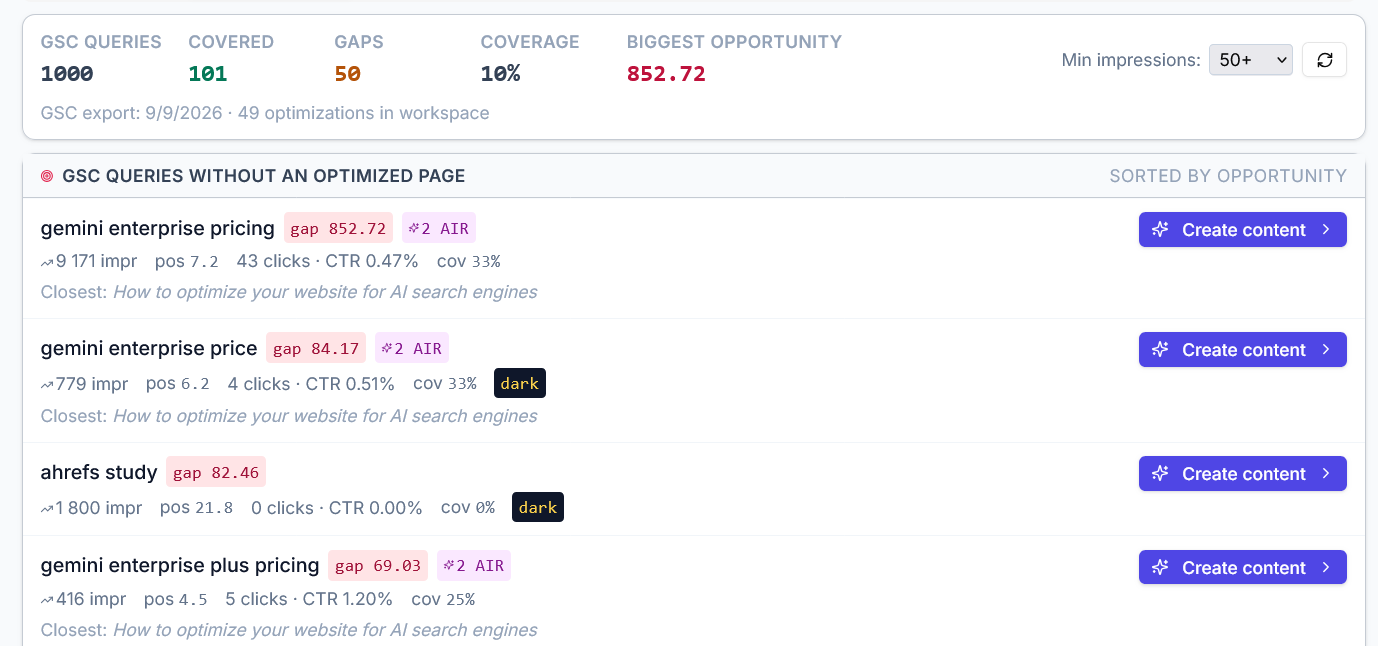
These are GSC search queries matched against content in the workspace, not a record of people's AI conversations. Coverage is the tool's content coverage, not AI market share. The 50 displayed gaps form a list selection; do not read them as every uncovered question.
Open original image in a new tab ↗Meet Ulf and Pippa — evaluate first, then improve
Ulf evaluates content across the three layers. Pippa helps refine text and structure. Their suggestions still need human editorial review: are the facts correct, does the tone fit, and does this help the reader? After publication, measure actual visibility and contact separately from the audit.
Common mistakes: Asking the numbers to say too much
- Calling an improved readiness score more AI citations.
- Comparing 125 days with 92 days and presenting the difference as a year-over-year effect.
- Adding AI impressions to search impressions that already include them.
- Counting phone clicks and thank-you-page visits as deduplicated, qualified leads.
- Promising that llms.txt, schema or an updated date alone delivers results.
- Treating all AI bots alike: search access, user-triggered retrieval and model training serve different purposes.
If you are unsure, start by writing down what the measurement actually counts. That is often enough to make the next decision more confident.
AI usage: Keep the source, date and population with the number
Historical ChatGPT baseline: OpenAI reported on 15 September 2025 that ChatGPT had around 700 million weekly users in mid-2025. The study's 1.5 million conversations were an analysis sample, not a daily message count.
More recent disclosure: on 11 September 2026, OpenAI wrote that its infrastructure supports products used by over one billion people each week. The source refers to OpenAI products; it must not be rewritten as one billion monthly ChatGPT users.
These are different populations, not a like-for-like growth calculation. Neither figure tells you how many people in your particular audience use AI to select a supplier. Investigate that through your own customer questions and measurements.
Frequently asked questions
What is the difference between SEO and GEO?
SEO concerns discovery, indexing and visibility in search. GEO emphasises making content understandable and usable as a source in AI answers too. The work overlaps; you do not need to abandon people or traditional search.
How long does it take to see results?
The first signs of AI visibility can appear quickly. Nettpilot’s published EntityMap case describes a page published on 5 June 2026 and relevant Google AI Mode answers to two named queries on 7 June — 48 hours later. Nettpilot also reports that its Norwegian article about choosing suppliers when starting an online store appeared in Google AI Overviews 24 hours after publication with 3LA Optimizer. The 24-hour timeline is Nettpilot’s own observation and has not been independently verified here. These are two individual cases on different AI surfaces, not a typical turnaround time or controlled evidence of the effect of Optimizer or EntityMap alone. Early visibility is not the same as sustained citations, traffic or enquiries. Record publication time, query, AI surface and observation, then keep following the results.
Do I need llms.txt to be cited?
No. This guide treats llms.txt as an optional format proposal, not a universal requirement. Prioritise accessible HTML, clear answers and verifiable sources. Our evidence does not support a percentage uplift promise for llms.txt.
Does a 3LA audit measure actual AI citations?
The audit evaluates readiness. Actual citations need reports or observed AI answers as evidence. Search Insights can use exported data, but that is a separate measurement from the audit.
Do more AI impressions mean more leads?
Not necessarily. Impressions show exposure, while contact goals are measured on the website. Connect source, entry page and goal, and check duplicates, spam and qualification before reporting leads or sales.
Where do I start if I am not technical?
Choose a question customers often ask and check whether the most important page answers it clearly. Use the checklist to identify one improvement. Ask for help with technical access or measurement setup if that is what stands in the way.
What is structured data and why does it matter for GEO?
Structured data (typically JSON-LD using Schema.org) provides machine-readable context about entities, relationships and facts on a page. AI crawlers use it to verify claims and decide whether content is authoritative enough to cite. Without structured data, AI engines rely solely on unstructured text, which reduces citation confidence.
What is Share-of-AI-Voice?
Share-of-AI-Voice measures how often your brand is cited in AI-generated responses relative to competitors for the same set of prompts. It is the AI equivalent of Share-of-Voice in traditional media monitoring. Brand Analyzer tracks this across GPT, Claude, Gemini, Perplexity and Mistral.
What is a Dark Topic?
A Dark Topic is a question your audience asks AI engines where you have relevant expertise but are not cited in any model's answer. AI Insights identifies these gaps by cross-referencing your content footprint with observed AI search patterns.
How does answer-first format improve AI citability?
Answer-first (or BLUF — Bottom Line Up Front) means placing the direct answer in the first sentence, then supporting it with evidence. AI models extract information in chunks; pages that lead with a clear answer are significantly more likely to be selected as a citation source than pages that bury the answer after a long introduction.
Sources and measurement basis
The practice cases use supplied exports and screenshots, not controlled experiments. Periods and limitations accompany the figures. The historical LayerScore sample is a separate analysis, distinct from the practice cases.
Our partners


Our customers








Find your next improvement
Start with content readiness. Then follow visibility and contact through clearly defined measurements.
Start with a 3LA audit →