Practical resources for improving your visibility in AI-generated answers, traditional search and human-first content. Each tutorial separates what you can measure from what you should change — so you invest in the right layer first.
Why does AI visibility matter?
Research from Princeton, Georgia Tech and the Allen Institute for AI shows that GEO optimisation strategies can collectively increase visibility in generative engine responses by up to 40%, though the effect varies across domains (Aggarwal et al., KDD 2024).
According to Ahrefs, ChatGPT now handles approximately 12% of Google's search volume. Bing reports that AI-generated answers appear on more than 30% of queries. When AI answers a question directly, the user may never visit a traditional search result — making AI readiness a business-critical layer alongside SEO.
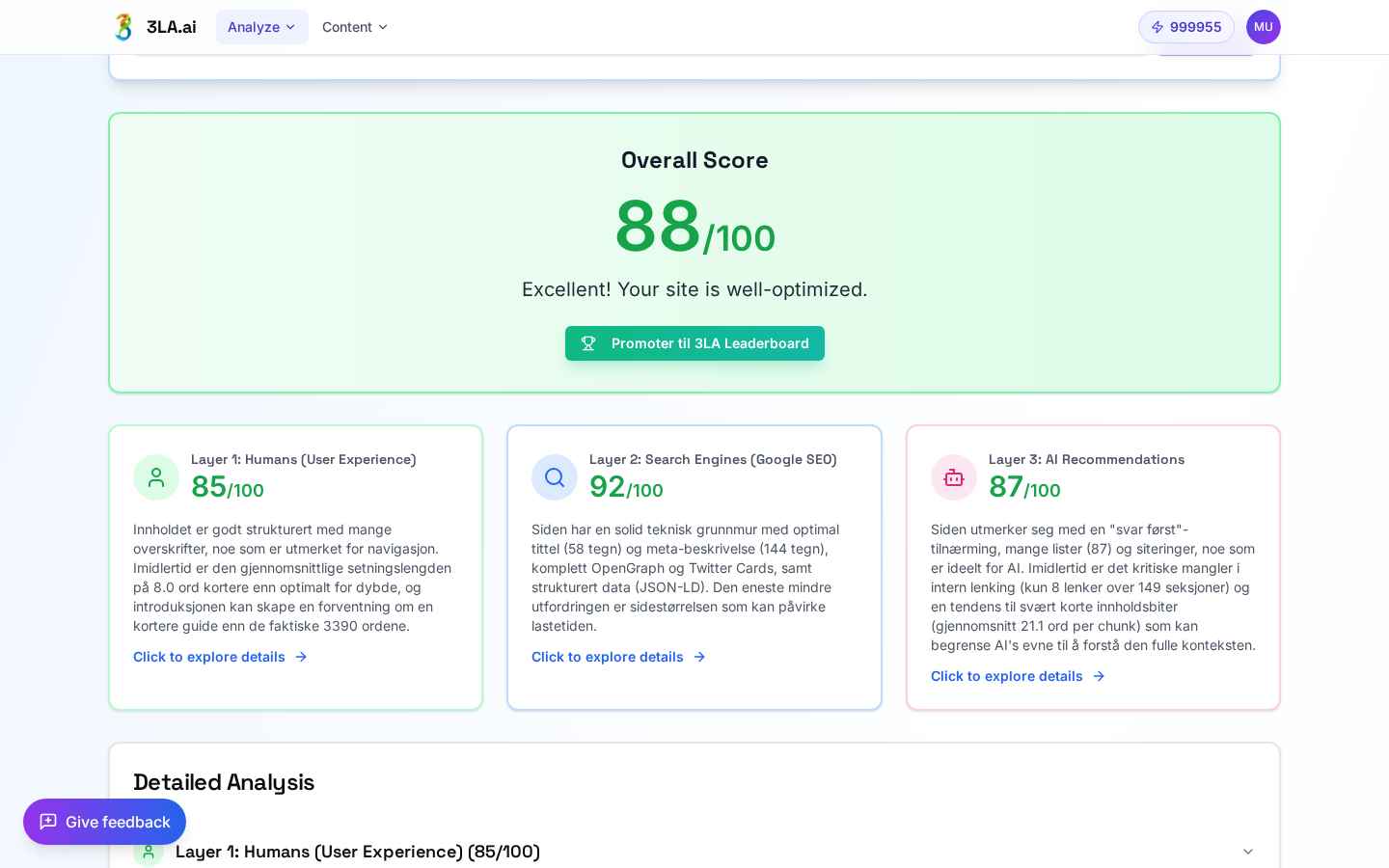
The Three-Layer Approach separates human readability (L1), search engine access (L2) and AI citation readiness (L3) into distinct, measurable layers. Our analysis of 406 domains (2,093 audits, updated every 15 minutes) shows that Layer 3 is the weakest layer on 54% of sites, with a median LayerScore of 61.5 out of 100.
How to separate AI readiness from SEO — and why they require different actions
How to read a three-layer audit and identify the weakest layer on your site
How to track AI citations, mention rates and contact goals as distinct metrics
How to structure content so AI models can extract and cite it accurately
How to use server logs and bot traffic data to verify which AI crawlers visit your pages
Choose a topic
GEO Guide for Content Editors
Learn Generative Engine Optimization through documented practice cases. Separate AI readiness, citations, contact goals, and find the next step for your content. Includes the BOVG case study, Princeton research data, and a 90-day implementation roadmap.
Understand the three layers: human usefulness (L1), search access and understanding (L2), and AI readiness (L3). The framework connects audits, content improvements and measurement into a single workflow.
In-depth resources on the economics of AI attention, platform-segmented GEO strategies, and the Three-Layer Approach methodology. Based on primary sources and verified data.
Generative Engine Optimization (GEO) is the practice of making your content more visible and citable in AI-generated answers from ChatGPT, Gemini, Perplexity and similar tools. Unlike traditional SEO, GEO focuses on citation readiness: whether an AI model can extract, attribute and reference your content accurately.
Do I need GEO if I already do SEO?
Yes. SEO ensures search engines can find and index your pages. GEO ensures AI models can cite your content when generating answers. According to our analysis of 406 domains, 54% score weakest on the AI layer — even when their SEO is strong.
How long does it take to see results?
Most sites see measurable changes in AI citation metrics within 30–90 days of implementing structural improvements. The 90-day roadmap in our GEO guide provides a step-by-step plan with weekly checkpoints.
Is this relevant for Norwegian businesses?
Yes. AI-generated answers are language-agnostic in structure. Norwegian businesses compete for AI visibility in both Norwegian and English queries. Our case study with BOVG (a Norwegian building company) shows AI assistant conversions growing from 2 to 18 (+800%) after content optimisation.
Resources from the team
Become a 3LA affiliate or partner — Agencies and freelancers specializing in SEO, WordPress, and AI visibility can now generate recurring revenue and access steep software discounts by partnering with the Three-Layer Approach (3LA). This program rewards partners for referring clients to 3LA's optimization framework while boosting their own search and AI discovery.
LayerScore HTML Analyzer — Paste a page's HTML and get a deterministic L1 / L2 / L3 score against the 3LA metric system, an Ulf diagnostic, and an exportable JSON report. Useful if your firewall is blocking our crawler.
Why measure AI visibility when models change constantly. — Discover why measuring AI visibility is critical. Learn how Generative Engine Optimization keeps your brand trusted by ChatGPT, Claude, and Gemini. Measuring AI visibility has become an extremely moving target. New large language models (LLMs) and advanced autonomous agents no longer just reply with static text snippets pulled from a single source. They reason, verify multiple sources in real-time, and tailor the response uniquely to each user based on context.
Architecting the AI Ground Truth with the 3LA AI Search Readiness platform
The 3LA Insight Engine |The Semantic Architecture Audit of an article from University of Copenhagen
The Architecture of an AI Citable Website
Synlig.ai 3LA audit - raw audit from 3la.ai
Hacking the Algorithmic Narrative: The AI Reality Audit with Nettpilots 3LA Framework
Majestic podcast: - SEO in 2026 - Additional Insights:Most sites have high search visibility but zero AI citations - with Nickolass Jensen
Nina Furu Podcast (NO): AEO / GEO: Testen som avslører problemene - med Nickolass Jensen